
The Cloud Has an Anchor Problem

Sherpa’s Editorial Board
Almost everything that crosses an ocean travels through a few hundred glass threads lying on the seabed — and the people who own them now answer to Meta, Google, Amazon and Microsoft. Lately they keep getting cut, one ship’s anchor at a time.
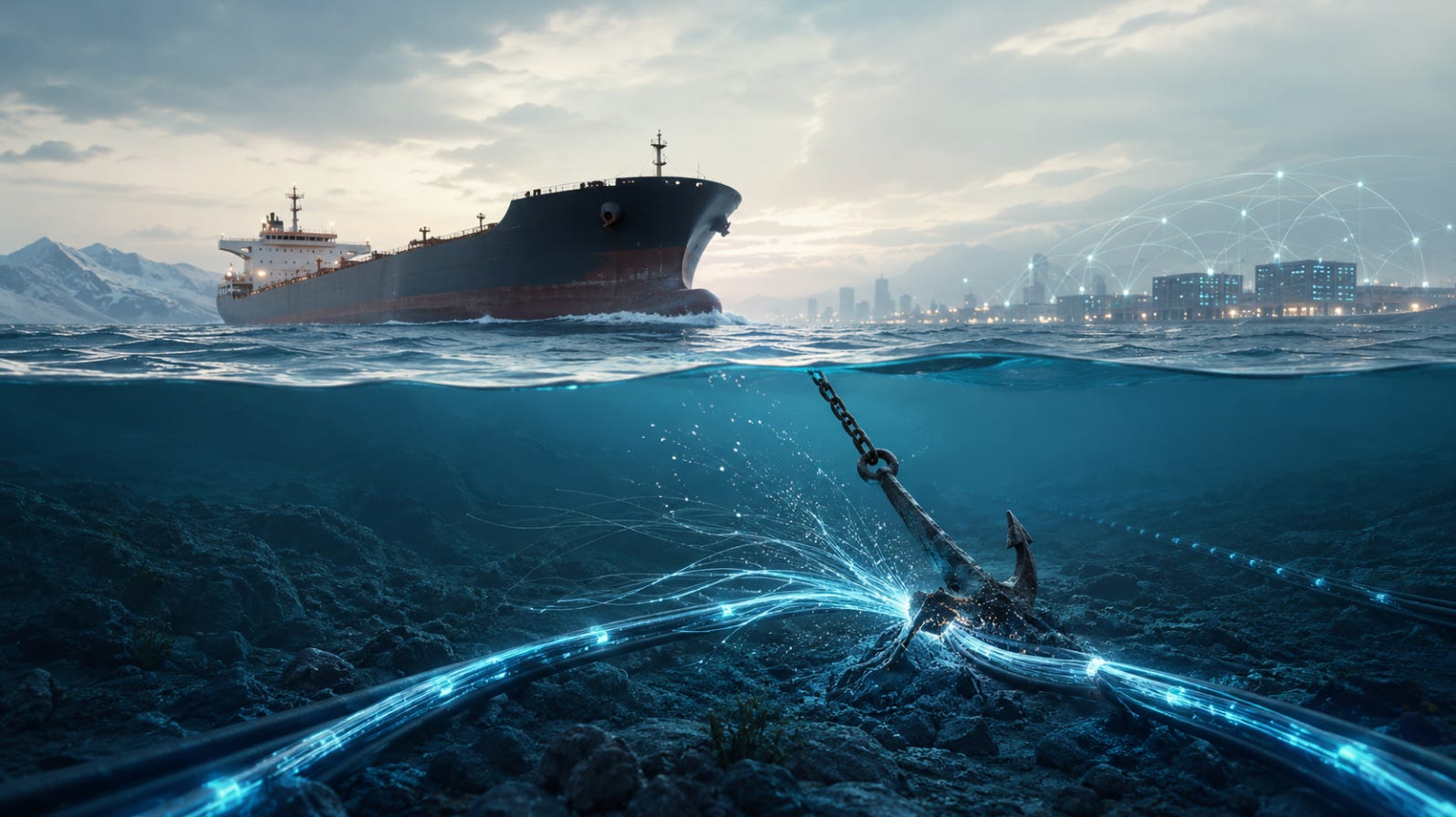
On Christmas Day 2024, Finnish Prime Minister Petteri Orpo was at home with his family when the Border Guard called. An ageing tanker named the Eagle S — Cook Islands flag, Russian energy cargo in its hold, bound for Egypt — was dragging its anchor across the floor of the Gulf of Finland. By the time anyone grasped what was happening, it had raked the seabed for some sixty miles, severing a power link to Estonia and several telecommunications cables along the way. Orpo then did something prime ministers almost never do over a single anchor: he authorised special forces to drop onto the ship by helicopter and take control of it.
The striking part isn’t that it happened. It’s that hardly anyone in Finland noticed their connection to the world had just been damaged — the traffic quietly rerouted — and that this was the third such incident in the Baltic in fourteen months.
We talk about the internet as a cloud, a weightless thing humming somewhere above us. It is nothing of the sort. Roughly ninety-nine percent of the world’s intercontinental data — every byte that crosses an ocean — travels through fibre-optic cables resting on the seabed. Not satellites. Not the ether. Glass. There are around six hundred such cable systems in service or under construction, threaded through more than 1.4 million kilometres of ocean, and in deep water much of that cable is no thicker than a garden hose. The entire apparatus of modern life — bank settlements, video calls, the endless conversation between one data centre and the next — rests on a few hundred fragile strands that you could, in principle, cut with a ship’s anchor. People do. Constantly.
The boring truth first
Here is the first thing worth understanding, because it cuts against the headlines: cables break all the time, and it is almost never sabotage. The industry logs around two hundred faults a year, and roughly two-thirds are caused by the dullest forces imaginable — fishing trawlers and dragged anchors. Earthquakes and equipment failure take most of the rest.
You rarely hear about any of it, and that is the system working as designed. Capacity is spread deliberately across many cables, so when one fails the traffic slides onto the others while a repair ship is dispatched. The network’s quiet genius is that its failures are usually invisible. Redundancy is the whole business model.
Which leads to the second, less comforting fact. The ships that mend these cables are a small, ageing and quietly endangered fleet — somewhere around sixty vessels worldwide, many of them near the end of their working lives. TeleGeography’s research suggests that by 2040 roughly half the global cable fleet, and about two-thirds of the dedicated maintenance ships, will have reached the end of their service life, with something on the order of three billion dollars needed to renew them. A single repair can run one to three million dollars and take weeks or months, depending on where the break is and which ship is free. A single cut is survivable. The nightmare is several at once, in a region with few ships, during a crisis — when redundancy runs out and there is no one nearby to splice the glass back together.
When the accidents stop looking accidental
For most of cable history the great enemies were trawlers and tectonics. Lately the enemy has started to look deliberate. One industry tracker counted forty-six publicised cable incidents in 2024 — the most since it began keeping records in 2013, and roughly triple the prior year.
The Baltic is where the pattern is clearest. In October 2023 the Chinese-flagged Newnew Polar Bear dragged its anchor across the seabed, damaging the Balticconnector gas pipeline and a data cable between Finland and Estonia; Beijing eventually acknowledged the vessel’s involvement and blamed bad weather. In November 2024 the Yi Peng 3, a Chinese bulk carrier that had left the Russian port of Ust-Luga loaded with fertiliser, dragged its anchor for more than a hundred miles and cut two cables — the C-Lion1 between Finland and Germany, and the link between Sweden and Lithuania. It was shadowed by European warships, briefly held, then released. Then came the Eagle S on Christmas Day. German Defence Minister Boris Pistorius spoke for a lot of officials when he said no one believes cables like these are severed by accident. Anchors, after all, do not drag themselves. NATO responded in January 2025 by launching Operation Baltic Sentry to patrol the waters.
The same script is running in a different sea. In early 2023, two cables to Taiwan’s Matsu Islands were cut, leaving residents offline for weeks. In January 2025 a Chinese-linked vessel was suspected of damaging a cable north of Taipei; in February the Hong Tai 58, Togo-flagged with a Chinese crew, cut a cable to the Penghu Islands — and this time a Taiwanese court convicted the captain and sentenced him to three years, a first of its kind. Taiwan logged five cable faults in 2025, up from three in each of the two prior years. Beijing’s line never varies: a common maritime accident, exaggerated for political effect.
And then the Red Sea, the ugliest demonstration of how a regional war becomes a global outage. On 18 February 2024 a Houthi missile struck the cargo ship Rubymar; the crew abandoned it; it drifted for days, anchor scraping the bottom of one of the most cable-dense waterways on earth, before sinking around the start of March. That anchor severed three of the cables packed beneath the Red Sea, disrupting about a quarter of the traffic passing through and sending ripples as far as East and Southern Africa. The Houthis denied targeting the cables — and almost certainly lacked the means to reach them directly. It didn’t matter. The White House’s John Kirby attributed the cuts to the Rubymar‘s anchor. The lesson is uncomfortable and cheap to apply: you don’t need to attack the cable. You only need to make the water above it dangerous.
The part that belongs on a balance sheet
For Global Infrastructure Sherpa readers, the most consequential shift is happening on the cap table, not the seabed. Historically these cables were built by consortia of national telecoms operators — too expensive for any single firm, so everyone chipped in and shared the strands. That model is dissolving. The hyperscalers are now large enough, and hungry enough for bandwidth, to build their own.
Google already owns private cables outright — Curie, Dunant, Grace Hopper, Equiano. Amazon recently unveiled its first wholly owned system, Fastnet, running from Maryland to County Cork in Ireland. And Meta, an anchor backer of the 45,000-kilometre, 33-country 2Africa consortium, has gone furthest with Project Waterworth: a sole-owned cable of around 50,000 kilometres, reported to cost in the region of ten billion dollars, linking the United States to India, Brazil and South Africa — and pointedly routing around both Europe and China. Somewhere near sixty new cables are planned before 2027.